Showing posts with label Laini Taylor. Show all posts

Saturday, December 28, 2019

Rutabaga's Reads 2019: Part 21

As Laini Taylor’s writings are works of beauty and art that most can only dream of achieving, I decided it would befit this duology to have its own post. Note: Spoilers are present in the “Muse of Nightmares” section.
Strange the Dreamer (Mar. 28, 2017) by Laini Taylor.
Growing up as a foundling, alone and unloved, and given the name Lazlo Strange (“Strange because that was the surname given to all foundlings in the Kingdom of Zosma and Lazlo after a monk’s tongueless uncle” since the monks didn’t think he’d live anyway), it is perhaps unsurprising that Lazlo is sustained by his dreams and stories of a city called Weep. It had a different name once, but when the Godslayer came, Weep’s true name disappeared as if by magic. Fate perhaps looked upon Lazlo when once he had to deliver manuscripts to the Great Library of Zosma. He never returned to the monks. Delving deep into folktales, fairytales, myths and legends, hiding under dust though they were, Lazlo was engrossed. He was found days later by Master Hyrrokin, who told him, “The library knows its own mind. When it steals a boy, we let it keep him.” On his own time, Lazlo pieces together whatever he can about Weep (which he calls the Unseen City), even teaching himself what he can of their language. Imagine his surprise when the Godslayer himself, Eril-Fane, arrives in Zosma with a contingent of Tizerkane, but it is Thyon Nero, the alchemist (who distilled azoth), who steals his spotlight. Until. Until he bursts aloud to Eril-Fane, in Unseen, not like a language coated in dust and commonness, but in reverence, like the precious gem it is. So Strange the Dreamer goes with Eril-Fane and the Tizerkane.
            Sarai, the Muse of Nightmares, is a nightmare-weaver. One of five blue-skinned godspawn, she is one of the child survivors of the Carnage. In that attack, it wasn’t only the savage gods that were slain, it was the children, too. Age didn’t matter. Blue skin = death. When Sarai takes one smithereen of darkness (a moth) to visit Lazlo’s dreams, she’s thrust into a place, not of fears and nightmares, but of strange loveliness and imaginative wonderment. Sarai, Sparrow, Ruby, Feral and Minya reside in the floating citadel overhead, which blocks out the sunlight for the townspeople below (the people of Weep do not know they exist). Minya wants Sarai to be nightmare victorious; the nightmares Sarai weaves in a person’s mind should be as bad as can be “for vengeance.” And how easy it is for Sarai to take a person’s dreams and make them into nightmares, “For what was a person but the sum of all the scraps of their memory and experience: a finite set of components with an infinite array of expressions” (p. 146). Lazlo changes that for her. He isn’t a nightmare; he is her dreamer.
            There is magic in the title and within the story, just as there is the beauty of connection and the ugliness of discrimination. Taylor’s writing is so lyrical that it’s like reading a graceful dance. The world-building is remarkable, the plot has depth, and the setting can be dark or lush or both at once. I was enthralled and could bask in the gorgeousness of the author’s prose for several wandering days. For anyone who’s read Taylor’s Daughter of Smoke & Bone trilogy, this is a must-have for one’s bookshelf, not solely because of the elegant writing, but for the references to that trilogy, one that has me hoping she’ll write more books that tie together with these two series.
Muse of Nightmares (Oct. 2, 2018) by Laini Taylor.
Not everyone has fled Weep. Eril-Fane and Azareen remain, along with some of the Tizerkane, including Ruza and Tzara, faranji Calixte Dagaz and Thyon Nero (the “golden godson”) and Eril-Fane’s mom, Suheyla. The last time anyone saw Lazlo, he was flying on a mesarthium creature (called Rasalas, but remade) up to the citadel, bearing the body of Sarai a.k.a. the Muse of Nightmares, in his own Mesarthim blue. There, he has met the other demigods (or godspawn, derogatorily): Sparrow (Orchid Witch), Ruby (Bonfire), Feral (Cloud Thief) and Minya (Minya is all there is). Minya, jealous of Lazlo’s gift and with a hold on Sarai’s tether, plans to use the threat of Sarai’s evanescence to exact her revenge on the city, no matter that she looks like she’s six years old. They incapacitate Minya (for her own good), so her violent threat is at bay, but Lazlo and the others need to decide where to go next. There’s also the matter of supplies, as they could use real food and decent clothing.
            Also centering in this tale are sisters Kora (Korako Nyoka-vasa) and Nova (Novali Nyoka-vasa). Seen in Nova’s flashbacks, they were inseparable until a young Skathis kept Kora for her astral (“of the stars”) gift and dropped Nova out of the ship like trash, not because she lacked a gift, but because he feared it. She’s a pirate. Hundreds of years ago, Kora asked Nova to do the impossible and travel across worlds – entire worlds! – to find her. Nova did, but she was too late. Instead of her beloved sister, she sees someone who looks like Skathis and has his gift, but isn’t, and she steals it anyway. Wraith, known for winking in and out of existence, is more obviously present, but why? And what will Nova do when she’s in denial of Kora’s absence?
            Anyone familiar with Taylor’s Daughter of Smoke & Bone trilogy will recognize references to the worlds in which they take place, which pleases me greatly, as I hope these characters will all one day converge like a new Avengers masterpiece, but literary. Taylor’s character-driven plot and impressive world-building are fluid and graceful. It’s like gliding down an exhale after dancing up an inhale. The writing is ornate and beautiful. “Muse of Nightmares” is an exquisite fantasy where moths are epic, nightmares are the norm and dreams are lovely things just out of reach (unless you’re Lazlo Strange; his Dreamer’s Weep is a sight). The story is weighty and complex, luxurious and rich. I am captivated yet again by Taylor’s wordsmithing.

Additional Notes:
·   Cataclysm: when one of the two Sixes cut a door too far between worlds, opening into darkness and loosing the darkness that’s alive
·   Continuum: the great All, an infinite number of universes lying pressed together like pages, which can be traversed through portals
·   Faerers: the lightbearers, seraphim who created those portals between worlds
·   Mesarthium: blue metal of the Mesarthim (“Mesarthium is no ordinary metal, for it is perfectly adamant: impenetrable, unassailable.”)
·   Uzumark: an intricate network of waterways carving through the bedrock of Weep
·   Yeldez: a courtyard house

Gods/Goddesses:
·   Skathis: god of beasts and high lord of the Mesarthim, “most monstrous of them all”
·   Isagol: goddess of despair
·   Korako: goddess of secrets
·   Letha: goddess of oblivion
·   Vanth: god of storms
·   Ikirok: god of revelry who served as executioner “in his spare time”

Terms:
·   al-Meliz: toward Meliz
·   ez-Meliz: away from Meliz

Worlds:
·   Earth: world of people like you and me
·   Eretz: world of the chimaera, which runs parallel to Earth
·   Meliz: world of the seraphim
·   Mesaret: world with the extraordinary blue metal that made its people like gods. “With their skyships and soldier-wizards, they were invincible. For a time.”
·   Var Elient: world with the red sea, called Arev Bael, which contains impressive monsters and tezerl stalks grow out of the sea
·   Zeru: world in which this duology takes place

Monday, May 21, 2018

Rutabaga's Reads 2018: Part 4

Always feel free to agree otherwise, but I feel like companion novels have become quite popular. I never got into them when they were featured as e-books you could purchase; I didn’t even own a tablet until one of my tech-savvy brothers gave me one a couple Christmases back. But when they are released as physical companion novels, I read them when they’re from series that I have followed/am following. A few are featured below.
            Please note that publication dates refer to the physical book and not the e-book, if an e-book was its first manifestation.
From Percy Jackson: Camp Half-Blood Confidential (May 2, 2017) by Rick Riordan.
Like navigating a new school for the first time, arriving at demigod training camp can be overwhelming. Sure, it probably beats surviving outside the magically protective border of Camp Half-Blood by yourself trying to outrun and outwit monsters that are attempting to kill you. Oh, wait. You’ll have to do that in camp, except it’s okay, because you have fellow campers trying to do the same thing, and it’s under the guise of training. Not helping? Ah, well. This guide is a demigod’s real source of what to expect at Camp Half-Blood under the guidance of Percy Jackson and with help from others, including his girlfriend (Annabeth), assorted friends and Pete the Palikos. You will learn the answers to important questions such as “‘Face death?’ Am I going to die?” and “What is an omphalus*?” Also, yes, fine, the god Apollo plays an important role in this companion novel.**
            It may be that Riordan employed the use of “extra-dimensional construction to create impossibly deep storage,” for there is far more wit and humor than one might think possible for such a slim volume. As it is a “guide,” it reads as such with delineated sections and subtitles within those sections. If you’re like me and like stopping in between chapters, this volume, if time doesn’t allow you to read it in one sitting, makes it easy to pause. This companion novel complements the Trials of Apollo series and is a lively extra to read while waiting for the next installment from Riordan.

* If you are the first to respond in the Comments section with the definition of omphalus, you win a card. But only if I happen to have your mailing address. If you are the second Commenter – or beyond – on this post, I may still send you a card (A) if I have your mailing address and (B) if I have extra cards.
** Credit given to Apollo so that this post’s author does not spontaneously combust when he is in godly form again.
Night of Cake & Puppets (Sept. 12, 2017) by Laini Taylor.
   Jim Di Bartolo, illustrator.
Small but mighty. That is Karou’s best friend, Zuzana, affectionately nicknamed the “rabid fairy.” On a tall day, Zuzana stands just under five feet, but don’t let her size sway you into a false sense of safety. Zuzana is as fierce as they come with a personality to fit (cigarette-butt-flavored coffee anyone?). But her personality isn’t the focus here. What she wants is to sweep Violin Boy (his name is Mik, and he really does play the violin; they both work at the Marionette Theater of Prague) off his feet, not in a milquetoast, I-will-bat-my-eyelashes-and-wait-for-you-to-come-calling sort of way, but in a ready-or-not-here-I-come sort of way. And she has a handful of scuppies on hand. In other words, she has a handful of magic wishes at her disposal, and she’s got a plan. Rabid fairy with a plan? Watch out, Violin Boy!
            While I did have qualms about wanting to read this book, it’s a companion novel to an impressively fantastical trilogy, and also, I needn’t have worried. Taylor has a way of writing that is as beautiful as it is creative. Instead of worrying about sappiness so sweet that it detracts the biggest sweet tooth, I read about the treasure hunt that Mik went on to find Zuzana, his treasure, the ‘X marks the spot,’ and the magic she used to help him wonder and believe (think “peacock footprints”). This companion novel to the Daughter of Smoke & Bone trilogy is imaginative, snarky, magical and, yes, romantic.
            Fun fact (if you don’t know): The illustrator is the author’s husband.
Queens of Fennbirn (Apr. 3, 2018) by Kendare Blake.
In The Young Queens, there is something of a glimpse into the childhood journey of Mirabella, Arsinoe and Katharine. From birth to 13 years old, the young queens age closer to the teenagers first introduced in “Three Dark Crowns.” Triplet queens are born every generation when the Goddess decides it is so. From birth, Mirabella’s gift is strong, whereas the gifts of Arsinoe and Katharine feel weak. It is clear to outgoing Queen Camille (who leaves the island now that the triplets are born, never to see them again) that Mirabella will one day be the Queen Crowned. After spending their first six years together in the Black Cottage with Willa, the midwife, they are separated out to be raised within cities populated by those with related gifts. Those cities are Roland, Indrid Down and Wolf Spring. They are the elemental, poisoner and naturalist cities, respectively.
            The Oracle Queen showcases Queen Elsabet. Reigning 500 years before the newest queens, she was dubbed the “mad oracle.” It is said that she demanded the execution of three houses, along with a maid, for no reason. Strangely, all three houses and her maid were those she considered allies and a few were her best friends. Interesting, yes? To get the full picture of how Queen Elsabet allegedly went mad, this is a go-to account. There’s another Arron woman to be leery of (I don’t trust any Arrons), a war-gifted on the Black Council who’s jealous of a fellow war-gifted who’s commander of Elsabet’s Queensguard, and a despicable king-consort.
            A novella comprised of two short stories, there is new back-story if you already follow the trilogy. As in the first books of Blake’s latest trilogy, there is darkness of plot, and it is executed marvelously. The darkness festers and all manner of things come to light: anger, madness, rancor, jealousy and even loneliness. In seeing the young queens as children, we picture them when once they were of innocence and cared for each other. We see two of them struggle with their weak gifts. With Elsabet, we see chaos reign, though it isn’t all of her own doing. This is a sharp companion and a good addition to one’s Three Dark Crowns novels.

Saturday, July 12, 2014

"Dreams of Gods & Monsters" by Laini Taylor

“My wife likes to say that the mind is a palace with room for many guests. Perhaps the butler takes care to install the delegates of Science in a different wing from the emissaries of Faith, lest they take up arguing in the passages.” –Dr. Anuj Chaudhary
This is my favorite paragraph in the entire novel. It’s such an intelligent way for the author to convey that a fictional character – both a renowned scientist and a man of faith – can believe openly the construct of evolutionary history and Creationism. I just love it. So great.

Dreams of Gods & Monsters (Apr. 8, 2014) by Laini Taylor.
POSSIBLE SPOILER (that one would likely guess at, anyway): Karou and Akiva have allied their once-enemy armies with each other, however tenuously. The revenant chimaera and seraphim, the “beasts” and the “angels,” struggle against their instinct to slaughter the other and band together. But band together they must in order to have any chance of defeating Jael, captain of the seraphic Dominion army, the Empire’s high-bred, elite army. The ranks of illegitimate Misbegotten, of which Akiva and Liraz are a part of, have severely dwindled. The Second Legion, or common army, is the largest army, on middle ground, but their allegiance is unclear. And defeating Jael’s army is crucial to the populations of two worlds: Eretz, where the seraphim and chimaera all hail from, and Earth, where, well, humans do.
            If the comingling of their armies works, then perhaps Akiva and Karou can be together in love. But with all that goes on around them and the directions they feel pulled in, fate may keep them apart. Something else is also at play. Akiva has felt the awareness of something other, something hostile. But what is it?
            Eliza Jones is a newcomer to the story. She is a research fellow in evolutionary biology at the Smithsonian’s National Museum of Natural History. She studies butterflies, has a past she doesn’t like to dwell on and may be prophetic. What might any of that have to do with Akiva, Karou and company? (Keep an eye on Ziri, too.)
            There has been no escaping violence in Taylor’s YA trilogy, but there is less violence in this novel than the previous two. Probably because Karou and Akiva spend more time longing for love, peace between races and a home. Possibly a shared one. Taylor’s fantasy novel is spellbinding, not just because of the source material, but of her creative skill in writing. So often her words are poetic -- not “lunatic poetry,” as Zuzana mentions (love her humor), but poetic prose. For example, “Skin as black as a raven’s wing at the umbra of eclipse, and her hair was featherine, the soft rose of sunrise, and falling in pale shoals about her dark shoulders.” Practically lyric, no?
            Still, the book isn’t all intensely poetic, but light and darkness, victory and defeat, secrecy, enmity, togetherness, love. Resurrections begot and lives lost, thuribles filled and evanescence. From bodies whole to ashes in the wind. The plot is multilayered and strong, the writing meticulous and lengthy (over 600 pages long). Taylor’s story is a vale of terrific storytelling, gorgeously edgy and intense. Highly recommend!

Wednesday, February 6, 2013

Rutabaga's Reads 2013: Part 2

Welcome to Rutabaga’s Reads 2013: Part 2. Thanks to everyone who left comments about books you’ve read or are looking forward to reading.
Beautiful Redemption (Oct. 23, 2012) by Kami Garcia & Margaret Stohl.
The first novel in the series, Beautiful Creatures, is a motion picture that will hit theatres on Valentine’s Day. Will you read the books now? Won’t you? Either way, I don’t want to put in spoilers. But please indulge me as I blurt out a smattering of words regarding this fourth and final novel.
            Curses and secrets. Trials and tribulations. A button like a pile of bricks. Cake like cement. Love. Regret. Fear. Hope. Pain. Determination. Two times goodbye. Always loved.
            Confused? Read the books! Know what I’m talking about? Post a comment! When you enjoy a series, there is always something a little sad about reading the last lines of the last book. But “Beautiful Redemption” is executed well. Occasionally it borders on almost-too-sappy, but at the same time, that sappiness helps carry a main character through the book. Love conquers all. Love supersedes all. For Ethan and Lena, love feeds their story of beautiful redemption.
The Boy in the Striped Pajamas (Sept. 12, 2006) by John Boyne.
I saw the movie well before I read this book, but that didn’t make reading the book any easier. Bruno is the nine-year-old son of a commandant-father who’s been assigned leadership of “Out-With,” a concentration camp in Poland, by the “Fury.” Bruno has led a sheltered life when it comes to his father’s “job” and is therefore naïve about the land beyond the fence. His naïveté holds even when he meets Shmuel, one of the multitude in striped pajamas beyond the fence. He doesn’t realize the awful reality of why Shmuel “lives” there. He only wants to play games with him. Will Bruno visit Shmuel? Even though that would be forbidden? … And No Exceptions?
            Despite the extremely tough subject, it is not a graphic book. The storytelling is simple when the history is not. It is haunting and poignant. The story is seen from the viewpoint of a nine-year-old … but it’s certainly not a book for nine-year-olds. Junior high students and above, perhaps. Whatever you think or feel about the book, I anticipate that you’ll find it thought-provoking and discussion-worthy.
Cemetery Girl (Oct. 4, 2011) by David Bell.
Tom and Abby Stuart led seemingly idyllic lives until their twelve-year-old daughter, Caitlin, vanished. Abby has made plans to move on, but Tom refuses to believe she’s dead. Four years later, Caitlin is found alive. Already a child who disclosed little, she refuses to give up details as a now-sixteen-year-old. Tom’s desperate to get the facts, Abby is torn between the alive-Caitlin and the memorial-service-honored-Caitlin, and other characters involved range in level of interest. What truths will be uncovered? And what does Caitlin’s attitude toward her captor say about her psychologically?
            “Cemetery Girl” did not capture my interest. My lack of interest in the novel was due to annoying characters (the only character I liked was the dog) and a lack of the unexpected, though the storyline initially appeared promising. The book isn’t good, bad or ugly. It’s just okay.
            (For those concerned, there are multiple instances where one might want to clean characters’ mouths out with soap.) (Adult fiction.)
Days of Blood & Starlight (Nov. 6, 2012) by Laini Taylor.
Blue-haired Karou is back in the sequel to “Daughter of Smoke & Bone.” She is tasked to create revenants for the chimaera and is stuck in a “land of dust and starlight.” She is supremely angry with Akiva. The seraphim and the chimaera are ever at each others’ throats -- and too often, quite literally. Is there any end to the slaughter occurring on both sides? Why does so much blood spill? For vengeance? For power over the land of Eretz? For sick sport?
            Akiva struggles, too. He’s disgusted with himself and with his “people” (the seraphim). He’s torn and broken, but he’s also hopeful and sympathetic. “Mercy breeds mercy,” he says, and it begins with himself. Will other seraphim take to his cause? And help the “enemy?”
            This installment is as terribly violent as it is exquisitely imagined. It’s cunning. Brutish. Brutal. And yet beautifully written. “Death, death, death,” I said aloud one night, succinctly summing up what was happening and the violence of it, the carelessness and ugliness of it. This is not a book for the faint-hearted. Fortunately, Karou’s tiny, ferocious friend, Zuzana, brings much-needed humor to the story. I am definitely looking forward to the concluding novel!
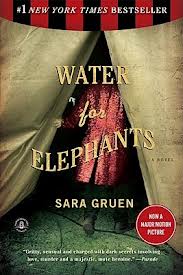
Water for Elephants (May 26, 2006) by Sara Gruen.
The story is told from Jacob Jankowski’s point-of-view. He is ninety. Or ninety-three. One or the other. Most chapters center on his life as a twenty-three-year-old almost-veterinarian. He finds himself employed as part of the Benzini Bros Most Spectacular Show on Earth as their vet. However, employed is a loose term, as he never gets paid. The circus isn’t just a circus of performers and animals, but bosses as well. There’s circus owner Uncle Al, who’s desperate to be like the Ringling Bros; superintendent of animals August Rosenbluth, who’s as charismatic as he is violent; and Marlena, August’s wife and a star circus performer. Jacob is immediately drawn to Marlena, which is most noticeable due to August’s extreme paranoia. When August’s abuse gets out of hand, and it’s seen that Uncle Al only cares about his circus, will Jacob heed his employer’s demands? Or will he attempt to do what he feels is right?
            “Water for Elephants” is as much an historical romance novel (Great Depression Era) as it is a novel of self-discovery and mental growth. I didn’t love this book, and sometimes, I didn’t even like it, but it is vivid and well-written. It’s not always an easy book to read. The novel volleys from charming to intense and from honest to sleazy, sometimes all within the same chapter. (For those who might like a heads-up, there are occasions of explicit material and expletives.) This is not a relaxed read, but it is rich in detail. What was your take on this book?

Wednesday, September 19, 2012

Rutabaga's Reads 2012: Part 3

This is Part 3 of Rutabaga’s Reads 2012. My aim in Part 3 is to include books which the male populace might find to be interesting also, as I realize many of the books I read lean toward female-interest. Please pass these book titles along to any upper middle-grade and young adult (YA) guys that you know (or guys in college or in general, for that matter)!

Daughter of Smoke & Bone (Sept. 27, 2011) by Laini Taylor.
What if the girl next door spoke multiple languages – not all of them human – and her hair was naturally blue in its current state? If you lived next to Karou, she’d be that girl. Karou is a seventeen-year-old living in Prague taking up art at The Art Lyceum of Bohemia, a private high school, and collecting teeth for Brimstone, the closest she has to a parent, and he’s also a chimaera. There are black handprints on doors and an unfriendly encounter with Akiva, an angel. Both of them have turbulent pasts, though Karou is initially unaware of this.
            Intriguing. Mystical. Strong. These adjectives describe the book for me. The book was buzzed about, and I can see why. This YA book is a supernatural romantic fantasy. There is forbidden romance and a war between races: the angels versus the chimaeras (demon-like to the angels). Yes, I mentioned romance, but it’s a story about more than just love and is much more interesting than just a sappy romance. This book is wonderfully imaginative, and I am looking forward to the next installment.
Divergent (May 3, 2011) by Veronica Roth.
On an annually appointed day, all sixteen-year-olds must choose the faction they wish to devote the rest of their lives to. For Beatrice “Tris” Prior, that day has come. The factions are based upon virtues: Abnegation (the selfless – she grew up in this faction), Amity (the peaceful), Candor (the honest), Dauntless (the brave) and Erudite (the intelligent). Tris’ decision will surprise not just herself and her family, but her entire faction. But very few know Tris’ secret. She is Divergent, for she displays equal aptitude for more than one faction. When she chooses, she finds herself thrust into a dangerously competitive initiation. At times downright ugly, it is hard for her to know who her friends really are and who means her harm or undoing. For example, is Four a frustrating friend or calculating foe? And when Tris figures out what is going on with a power-hungry faction, will she be able to stop it? Or will she be too late?
            There is more than one dystopian summary/review in this batch, and “Divergent” is one of them. Of all the dystopian novels I’ve read since “The Hunger Games,” this trilogy-to-be ranks right up there. Romance is not the key to this story. “Divergent” can be twisted and violent, so beware if you don’t like books on that order. In her debut, Roth creates a masterful and edgy dystopia, which is no small feat in a world currently digesting dystopian tales en masse.
Elsewhere (Sept. 9, 2005) by Gabrielle Zevin.
Fifteen-year-old Elizabeth “Liz” Marie Hall dies and finds herself in an afterlife unlike any other. Here, the deceased age backwards (like Brad Pitt’s character in “The Curious Case of Benjamin Button”), but when they reach infancy, they don’t die again, but are sent on the River to be reborn on Earth. That is the case with animals, too. Despite all the things Liz missed this time around on Earth, she finds love, new friends and gets to meet her grandmother for the first time in Elsewhere. And just because she’s dead doesn’t mean she’s lost her ability to throw a tantrum or find her way to the forbidden Well.
            This YA novel is fascinating, and I enjoyed the concept of aging backward and, eventually, starting anew again. Death is not something to be taken lightly, but in a book that isn’t only meant to be weighted down with the serious enormity of it all, Zevin includes some good humor. I recommend this book to anyone looking to read something that’s a little different, even for fiction.
Everlost: Skinjacker Trilogy #1 (Aug. 22, 2006) by Neal Shusterman.
After a car accident, previous strangers Nick and Allie are on their way to “the light” when they collide with each other and veer off course to Everlost. Call it what you will, be it purgatory or an in-between world, but Everlost is a “shadow of the living world, filled with all the things and places that no longer exist.” In this limbo realm, Allie and Nick still encounter dangers, including the McGill, who’s the monster of all monsters in this book. It is also in this limbo realm that Allie discovers she’s a Skinjacker and that she really can’t stand Mary “Queen of Snots” Hightower, self-professed know-it-all of Everlost and its inhabitants, the Afterlights. Allie and Nick are Afterlight Greensouls (new arrivals).
            This book is an imaginative and highly quirky-in-an-interesting-way read. The two books that round out the trilogy are: “Everwild” (Nov. 10, 2009) and “Everfound” (May 3, 2011). Death can be such tricky subject matter, but Shusterman adroitly handles it in a very vivid, unique way with splashes of humor. I recommend this to anyone, but especially to reluctant male readers.
I Am Number Four (Aug. 3, 2010) by Pittacus Lore.
John Smith is an alien on Earth, but he looks like us, and he talks like us. He is one of nine Garde who escaped from their home planet of Lorien, along with their Cêpan, and scattered here. But the first three have been found and killed by the enemy Mogadorians. John Smith is Number Four. Through his Legacies, he is learning more of the history of his home planet (including its destruction) and also coming into his supernatural powers. He and his Cêpan, Henri, must often be on the run, and John is tired of it. He is happy in his newest place in Ohio. He’s made a friend, Sam, and has a beautiful girlfriend, Sarah. But his desire to stay in Ohio leads the Mogadorians to him and puts them all in danger. Can they all make it out alive? Or is Four’s time up?
            This is a very good read if you like sci-fi/fantasy, action and some suspense. There is a small bit of teen love, but nothing to bog down the excitement of the story. There is minimal foul language, but it shouldn’t stop anyone from reading this book. It contains good action. The next two books in the series are also available: “The Power of Six” (Aug. 23, 2011) and “The Rise of Nine” (Aug. 21, 2012).
Incarceron (Jan. 26, 2010) by Catherine Fisher.
Sapphique (Dec. 28, 2010) by Catherine Fisher.
Incarceron is a prison, but it’s not just any prison housing inmates. This prison is alive. It constantly watches the activities of those who dwell within. Finn is one of those trapped in Incarceron. He cannot remember his childhood, but he believes the tales of Sapphique, about the only prisoner ever to escape Incarceron to the Outside, and he’s determined to be the second with the help of a crystal key and Claudia Arlexa. Claudia is the daughter of Incarceron’s Warden and resides on the Outside, but she wants Finn’s help, too, as she is desperate to escape an arranged marriage to Caspar, the Crown Prince of the Realm. She doesn’t like him at all.
            In Sapphique, Finn has escaped to the Outside and is with Claudia, but he worries of the friends that are still trapped in Incarceron. The Outside is not at all what he expected. Though harsh and violent, the prison was technologically advanced. Outside, where the people are adhering to Protocol, technology is not allowed to be used by the general populace, now including him. Most are poor. The Outside feels like another kind of prison to Finn. Inside, his friends are trying to find a way out on their own, but to do so they are in search of a magical glove, which legend says Sapphique used to get out. But they’ll have to fight Incarceron, because the prison wants it, too. Can those on the Outside overthrow Queen Sia? How will it end for the people? And for Incarceron?
            These YA novels are both well-written and move quickly. Though the Outside looks older than our time, it is a future world, a dystopian one. It is not intensely violent like “The Hunger Games,” but it is set in a negative, anti-utopian world. Despite both books running between points of view in Incarceron and on the Outside, I never felt lost, for Fisher lays out the story and the characters quite well. It is complex. Read this if you enjoy science fiction, fantasy and/or dystopias and begin with “Incarceron.”
Inheritance (Nov. 8, 2011) by Christopher Paolini.
At 849 pages, this concluding book in the “Inheritance Cycle” reaches epic length. This saga follows Eragon Shadeslayer, a Dragon Rider, and Saphira Bjartskular, his dragon. They aim to conquer Galbatorix’s fearsome reign and restore peace to their homeland of Alagaësia. Already the duo have felt the triumph of battles won and endured the agony of painful losses, but they are not done yet. There are more battles to fight, including the finale with Galbatorix. Eragon will also have to make a great decision at the end. How will he fare in battle? What will he choose in the end? The story is told from multiple viewpoints: Eragon, Roran (his cousin), Nasuada (leader of the Varden) and, on occasion, even Saphira.
            If you’ve kept up with this saga over the years, I would enjoy hearing your comments on what you thought of the conclusion. My feelings were mixed. On the one hand, there were things resolved that I would expect to be, but the ending wasn’t as satisfactory as I would have expected at so many pages. Still, I recommend this to anyone who is a fan of fantasy and/or a fan of authors like Tolkien, as the world of which Paolini writes is reminiscent of other worlds and strange languages, elves and dwarves. Should you be considering reading this saga, prepare for the long haul, as you will need to start with book one if you don’t want to be lost in the land of Alagaësia or within all the characters.
Legend (Nov. 29, 2011) by Marie Lu.
Both fifteen years old, June Iparis and “Day” are from opposite sides of the track. And the track is the western coast of what used to be the United States and is now called the Republic. It is at war with its neighbor, known as the Colonies. June is a prodigy of intellectual and military grade. She is being groomed for success as she and her brother, Metias, were born into an elite family. Day was born in the slums of the Republic’s Lake Sector, and he is already a wanted criminal. Mostly his acts look to be anti-war-effort. Then he’s accused of killing Metias. June wants her revenge and will track him down, but Day just wants to save his family. The two will discover shocking truths about their Republic and the twisted way it goes about keeping its secrets.
            Told from the viewpoints of June and Day, Lu gives them each a distinctive voice with layers to their characters. She creates visual imagery in the story that plants rich pictures in the minds of the readers. The purported first book in a trilogy, this is a YA dystopian novel to pick up if you read “The Hunger Games.” I am looking forward to the next installments.
The Scorpio Races (Oct. 18, 2011) by Maggie Stiefvater.
Capaill uisce. This term refers to the water horses that come out of the sea and which residents (and a few brave outsiders) on Thisby Island catch and train to race in the annual Scorpio Races. They also hope to not die. These horses aren’t sweet little water sprites or a pet. No. These horses are drawn to the salty sea. And flesh. And drowning that flesh so they can consume it. Nice picture, huh? But the book is also a story about Sean Kendrick and Kate “Puck” Connolly. Sean is the brooding returning champion, while Puck is the first female registrant and a very determined young woman. Sean has his reasons for being who he is, and Puck just wants to save her family’s farm and keep her siblings together.
            This YA book is captivating. Exhilarating. A little bit fearsome (no capall uisce for me - *shudder*). This is the first book I’ve read by Stiefvater, though I know she is renowned for her “Shiver” trilogy. Subtle romance only, so guys shouldn’t feel the need to stay away from this book. There’s one particularly tough scene involving a capall uisce. For sure, this read isn’t for the greatly tenderhearted. But for those who like any of the following – Celtic myths, a story well-imagined, strong visual descriptions – and can stomach reading some violence, you may become a fan of Stiefvater, too.
The Serpent’s Shadow (May 1, 2012) by Rick Riordan.
In the final book of The Kane Chronicles, Carter and Sadie Kane are back to [hopefully] send Apophis, the Chaos snake, deep into the Duat where he belongs and restore Ma’at – order – to the world. As with the other two books, this one is alternately told by Carter and Sadie. Khufu is around, and Walt’s fate will come to pass. A crazy-pathological-liar-ghost-magician named Setne has entered the picture to offer “help,” and many others are in this book helping or hindering the beat-Apophis effort, both human and Egyptian god alike, familiar and maybe not so much.
            Rick Riordan’s books have been my replacement reads for Harry Potter (not that it can ever truly be replaced). Like Harry Potter, they are geared toward the same age group, but read enormously well at any age. They are fun and witty, and each novel takes you on an exhilarating adventure that’s filled with tough choices, tricky business, danger and the sort of timid attraction that comes in the oh-you-don’t-actually-have-cooties-and-are-rather-cute stage. As with his other books I’ve read, this one is vivid and tremendously imaginative. This is a must-read if you haven’t already introduced yourself to Riordan yet, but start with the first book (called “The Red Pyramid”). Or, if you’re more familiar with Greek mythology, begin with his Percy Jackson & the Olympians series.