Showing posts with label Shannon Hale. Show all posts

Sunday, March 10, 2019

Rutabaga's Reads 2019: Part 2

Welcome to my first middle-grade compilation of 2019! All three stories belong to ongoing series. I do my best to avoid spoilers, but I cannot guarantee that they are 100% spoiler-free. You have been forewarned!
The Golden Tower (Sept. 11, 2018) by Holly Black and Cassandra Clare.
*This is the final book in a series.*
What is it like to be both a hero and an outcast, a mage for good and a vessel of evil? Callum Hunt will know. He is beginning his final year at the Magisterium, a magical school where mages are taught, but this year he is shunned by some who called him friend in the past, and one of his best friends is not present like he’d like to be. The villain, the real “Evil Overlord,” is not shy about making himself known and visible, yet there are many who still do not trust Call, even though the Evil Overlord is unlike anything the mage world has ever seen. And in a world in which Devoureds and elementals exist, that is saying something. The Evil Overlord, stuffed full of malevolence and power-hungry greed, has demands, one of which is Call and his friends. They all expect to be killed, but it is possible to defeat this villain, though it will involve some travel and an assist from Call’s dad, Alastair. Support from the Assembly wouldn’t hurt, either. Now, about that voice inside his head …
            Brilliant. Magical. This fifth and concluding novel in the Magisterium series has been brimful of action, adventure, magic, fantasy and humor. However, the authors do not shy away from the darker, tough stuff, making obstacles a different sort of difficult than ours would be since they involve magic. It stuns with a plot complex enough to keep the interest of advanced readers, but is still easygoing enough for fans to read for the pure enjoyment of reading. For me, this series ranks right up there with Harry Potter or any of the mythology-based books by Rick Riordan. And I do not give that praise lightly!
The Legend of Shadow High (Oct. 17, 2017) by Shannon Hale & Dean Hale.
*This is a book within a series, but I don’t know if more will follow.*
Ever After High and Wonderland aren’t the only fantastical places that exist in the World of Stories. Monster High exists, too, with founders Frankie Stein (daughter of Frankenstein, obviously) and Draculaura (clearly the daughter of Dracula) going on an adventure they never dreamed of. They have heard whispers of a place called Shadow High. Unfortunately, the Evil Queen gets wind of this as well. Frankie and Draculaura are accidentally transported to Ever After High around the same time that the Evil Queen is missing from her mirror prison and then Madeline Hatter winds up kidnapped. Overseeing the narration of the tale is a Narrator by the name of Brooke Page. She is young and very new in the role of Narrator. Frankie and Draculaura team up with Raven Queen and Apple White and once they get over the fact that the others actually exist – for real – they work to rescue Madeline and save the World of Stories. Because if they don’t, and those margins crash together, their world will be destroyed. Their stories will no longer be. They’ll be a jumble of words, an effect of the Unmaking.
            As one who has enjoyed the Ever After High series of books, those written by Shannon Hale and Suzanne Selfors, I was happy to come across this one last year while perusing books. Like the others, this story is light-hearted and cute. It’s a bit of mystery within a safety net. In other words, mystery is present, but what leads up to solving it or getting through it isn’t nightmare-inducing. With the addition of Brooke Page and Madeline Hatter’s ability to hear the Narrator, there’s an added element of communicative ability involved in the story process. Brooke isn’t immune to fangirl-ing, adding to her youthful vibe. Puns, figurative sayings and trademark exclamations (like “fangtastic” and “spelltacular”) are always near at hand. If you’re a fan of the Ever After High series, and you haven’t read this already, this volume should meet your approval. It’s also a bit more interactive for you, the Reader, which can be a help or a hindrance if you like that sort of interaction in reading. Or don’t. (I don’t prefer choosing paths and jumping pages.)
Rise of the Isle of the Lost (May 23, 2017) by Melissa de la Cruz.
*This is the third book in a series.*
Are they rotten to the core no more? That might be pushing it, but the quartet from the Isle of the Lost, consisting of Mal (daughter of Maleficent), Evie (daughter of Evil Queen), Jay (son of Jafar) and Carlos (son of Cruella de Vil), have certainly come a long way from where they started. They’re each both in their elements and still finding their ways. Mal works to balance Auradon’s agreement to not use magic (except under highly regulated, exceptional circumstances) while being the girlfriend of the young king. Evie loves being in Auradon and shines as a fashionista and unofficial seamstress at Auradon Prep. Jay continues to understand teamwork instead of looking out only for himself and is accepting help to prepare for R.O.A.R. (Royal Order of Auradon Regiment) tryouts. R.O.A.R. is a combination of parkour and fencing (“It’s not linear. … Think of it as 3-D fencing.” – Li’l Shang, son of Li Shang and Mulan). Carlos also enjoys life in Auradon, especially now that he likes dogs, and he is excelling in school with technology his specialty. King Ben gets called away to moderate a dispute between Northern Wei and Agrabah at the same time that the Isle group decides to help Evie’s friend Arabella, niece to Ariel and granddaughter of King Triton. They need to find something before someone notices it’s lost and before Uma (daughter of Ursula), Harry (son of Hook) and other hooligans find it first.
            This middle-grade novel packs a rollicking adventure on land and at sea into a relatively slim volume. “Rise of the Isle of the Lost” features a perilous race that remains G-rated. I enjoyed the storyline, which included Uma and getting a backstory of her character and also the story behind the tension between her and Mal. As those two have mothers who are epic villains, it doesn’t take much for an ocean-size wedge to come between these past friends. King Ben gets to travel to two different areas of the kingdom, and I enjoyed the glimpse into different places outside of Auradon Prep and the Isle of the Lost. Although not wrought with intense complexity, this story is fun-filled and humorous with cleverness and heart.

Sunday, August 14, 2016

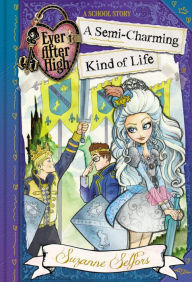
"The Storybook of Legends" by Shannon Hale

If you ever wander down the toy aisle, maybe you’ve noticed the Ever After High dolls from Mattel. This storyline was their idea. And if you like fairytales, it’s a very good idea!
            This review only covers the very first book in the first trilogy of the Ever After High series. The series continues with stories by Suzanne Selfors, all of which are as cutely enjoyable to read as those by Shannon Hale. I read this first book over 1 ½ years ago and had meant to review the three books by Hale, but since I never did, I thought I’d post the one-book review that I had written.
Ever After High: The Storybook of Legends (Oct. 8, 2013) by Shannon Hale.
Lately it seems that to be a fairytale villainess means you get to wear wickedly** awesome clothes. But Raven Queen doesn’t care. Hex no! She’s next in line to be the Evil Queen and poison dear, sweet Apple White – daughter of Snow White, of course – so she can be kissed by her own Prince Charming – whose name is Daring – and live happily ever after. Blah, blah, blah. The Evil Queen wants Raven to follow her gloriously evil example, but Raven has always been nice. Which is not hexcellent. The start of the school year is fairy-fail, as others around her are beginning to startle at the sight of her and even run the other way. As if that’s not enough, she has to chase down her advisor’s cottage just to get her class schedule and the one hextbook she wants she doesn’t have, because she was denied entrance to Muse-ic class on account that it’s not a villainous class. And this year is important for Raven, Apple, Daring and others. It is their Legacy Year, where they sign the Storybook of Legends and seal their classic storybook fates. Some will get their Happily Ever Afters. But for some others, like Raven, it has to be a Happily Never After.
            Or does it?
            I don’t care that this is a middle-grade novel; it is terrific fairytale fiction. Hale’s writing has depth, but not so much that it would confuse the target demographic (8-12-year-olds). Instead, she writes a wonderful plot, familiar in its utilization of fairytales, but focusing on their progeny instead, and unique in the presentation of the storyline. Her writing is full of humor and there is no limit on fairytale wordplay or the presence of magic. After all, it’s a fairytale-in-progress for these characters. Sure, there’s a bit of emphasis on clothes, but what do you expect? A princess’ wardrobe is important! (Besides, Mattel is never short on doll clothing and accessories.) This first book is fun but not completely juvenile, frothy and frilly but not without depth. It features a strong girl in a school full of the usual teenager angst, albeit with magical fairytale style, who wants to make her own choices. This story is good fun. Royally good!

** All puns are intended!
~   ~   ~   ~   ~
 Below are the chronological covers through 2016, NOT including companion novels.

Saturday, April 19, 2014

Rutabaga's Reads 2014: Part 5

The school year will close in less than two months, yet this is the first “Part Scholastic” post I’ve put together during the 2013-2014 academic year! I want to reiterate that I am in no way associated with anyone at +Scholastic. I am simply a strong supporter of the Scholastic brand!
Origin (Sept. 4, 2012) by Jessica Khoury.
Life is easy for Pia. All she’s wanted to do is become a scientist at Little Cambridge, which works well for her, as that is what she’s been trained to become since she was a toddler. Every few months she takes another Wickham test, and every single time she passes. So why isn’t she a scientist yet? Why doesn’t she know how to create Immortis? It is, after all, the sole reason she is what she is at all. Immortal.
            Perfect, immortal Pia. Tapumiri. Indestructible Pia who’s never left the gates of Little Cam to explore the rainforest beyond. Uncle Paolo has kept her in the dark about the outside world. Pia has a perfect memory and can proudly recite the scientific names and facts of plants. She can tell you all the parts of a paramecium. But she’s going to feel jealousy when she discovers that seven-year-old Ami knows more about the world than she does. And she may find what it means to love someone and struggle with logic (science) versus emotion (love). Because what Eio and the Ai’oan villagers know about Pia’s origin tells a truth story that Pia may not be able to handle. But if she can’t handle their stories, can she handle what Uncle Paolo and the other scientists at Little Cam have in store for her? What is her origin?
            The wonderfully smart and artistic thing about this book is that it appeals to a range of audiences. It’s part science fiction and part romance. It’s strict and sterile (Little Cam), open and free (Ai’oa). In one way, Pia is an impossibility – genetically bred to be immortal – but she’s also a believable teenager: totally naïve of the outside world, and her inner struggles reflect this. This page-turning novel of survival, truth and discovery is adventurous and satisfying, though the story isn’t without turmoil and death. The scientists are mainly one-dimensional, but the contrast of her settings – the sterile labs of Little Cam and the lushness of the rainforest – are terrific. Pick up this YA story if you want a reprieve from the usual (e.g. vampires).
Princess Academy: Palace of Stone (Aug. 21, 2012) by Shannon Hale.
For the mountain girls who attended the Princess Academy, the opportunity to visit Asland, the capital of the kingdom of Danland, is the chance of a lifetime. No longer are they just Mount Eskel girls, they are now nobles as Ladies of the Princess. Miri Larendaughter even gets to attend Queen’s Castle, the university. She is one part awed and excited for this opportunity, and one part overwhelmed. The weight of learning is on her shoulders, and she feels it. One of her friends even says to her, “Go learn for all of us.” Those are heavy words, even when it’s meant in kindness. Her best friend – will he be her betrothed? – Peter Doterson, is also in Asland working as an apprentice. And she meets a fellow scholar, a good-looking boy named Timon Skarpson (a potential suitor?).
            But alas, life doesn’t just revolve around boys or even school in Asland. There are murmurings of a revolution amongst the commoners. Unfair tributes and starving people, and Miri in the middle. She’s torn between her loyalty to the princess, one of her good friends, and to her new, Aslandian friends with their daring and their will to help “the shoeless.”
            This middle-grade story is a satisfying sequel to “Princess Academy.” I thoroughly enjoyed Hale’s world-building of Asland. She was descriptive enough for me to create a picture in my head of the land and the palace with its king’s wing of linder (think quarry speech) without bogging the book down with too many details. Hale’s writing is smart and vivid and makes the reader think. She focuses on ethics in this book -- how life is generally not just black or white, yet we have to make decisions which may be life-altering anyway. And those decisions make Miri a subtle hero. She may use quarry speech, but never outright violence. She’s much better at using intellect and bravery, which is a good lesson for us all.
            Book One: Princess Academy
Pulse (Feb. 26, 2013) by Patrick Carman.
Do you have a pulse? (Of course you do, you think. You can feel it right now in your neck or at your wrist.) But I’m not talking about that pulse, I’m talking about the pulse. It’s the year 2051, and Faith Daniels is going to discover that she has a telekinetic ability. This is called a pulse. A handsome and mysterious boy named Dylan Gilmore, a classmate, also has this ability, but that might not be all. Faith, Dylan and their classmates are being herded closer and closer to the Western State (there’s also an Eastern State). They live on the outside, and those outside of them, which we might consider homeless, are called Drifters. Some other classmates include Faith’s best friend, Liz Brinn, new friend/tech genius Hawk, and seemingly-perfect-in-all-ways siblings Wade and Clara Quinn. Faith doesn’t know it yet, but they’re preparing for a war. A war that needs her pulse and Dylan’s pulse, because, unfortunately, the other side has pulses, too.
            Dystopian fiction is still a common theme, and one of the things I found most intriguing is that the author set this just 37 years from now. Not 600 years or 300 or even 100. 37. The California coast slides into the ocean in 2025, along with three million people. A few years later, New Orleans gets swallowed up, as do another million people. There’s a global drought, and portions of Japan and China get swallowed up by the ocean, and then there’s a huge earthquake in 2029. That’s mentioned in passing when describing the route to the Eastern and Western States. “Pulse” is a fast-paced YA story. Though dystopian fiction is as common these days as vampires and witches, this story is fresh and original. There isn’t a lot of world-building, but the story scoots along swiftly enough that the lack of world-building shouldn’t visibly negate the suspense and action of the story. I would have liked; however, for Faith to learn about her ability earlier. Gaining knowledge approximately 185 pages in was too drawn out, I thought, but I still found the story to be a fascinating read. “Pulse” is the first book in a planned trilogy.

Sunday, November 18, 2012

Rutabaga's Reads 2012: Part 8

This is Part 8 of Rutabaga’s Reads 2012. It includes books I’ve read since Part 6 that are not picture books. What are you reading today? Let me know by commenting on Part 8’s post.
Breadcrumbs (Sept. 27, 2011) by Anne Ursu.
In a contemporary version of Hans Christian Andersen’s “The Snow Queen,” Hazel Anderson does not fit. An adoptee from India, she is too imaginative, most of her classmates treat her with contempt or simply give her the cold shoulder, and she’s only stuck at the school to begin with because her parents have divorced and money is tight; therefore, she had to leave her previous school. But she has Jack Campbell, and they fit together like the pieces of a fantastic puzzle.
            Or they did.
            Overnight, Jack seemed to find her disdainful. He suddenly quit talking to her and then he went away. Because something happened. A mirror shard fell from the sky and happened into his unsuspecting eye, traveled to his heart and froze it. Hazel goes off on a quest to rescue her best friend, albeit “in ill-considered shoes, brave and completely unprepared.”
            “Breadcrumbs” is a middle-grade novel that takes place in Minnesota and mentions Minnesota Twins baseball player Joe Mauer in the storyline. Ursu writes a creative story that is part fantasy and part realistic fiction. It is magical, but the magic is subtle. Ursu expertly weaves the realism with allusions to the modern-day stories we’ve read (“Weren’t wizards good? Dumbledore’s a wizard.”), but also to the well-known tales of yesteryear (“… but all she knew about wolves was that you should never tell them how to find your grandmother’s house.”). While Hazel’s flighty imagination can be trying, she is a heroine, and even more importantly, she is an awesome best friend.
Juliet Immortal (Aug. 9, 2011) by Stacey Jay.
You think you know Romeo & Juliet’s star-crossed love story.
            But what if Juliet died so Romeo could gain immortality and join the Mercenaries of the Apocalypse? And what if, consequently, Juliet also gained immortality by joining the Ambassadors of Light? In this rendering of the greatest love story, this is precisely what happened. Romeo has spent centuries inhabiting deceased human bodies to recruit more Mercenaries through murder. Juliet has only returned to Earth about 30 times over the past 700 years. She works to bring soul mates together – to spread love and light.
            Juliet inhabits Ariel Dragland, who is not dead. She has to find the soul mates she should be helping and bring them together before Romeo negatively interferes. Romeo has reanimated the fresh corpse of Dylan Stroud. But extra trouble lurks. Juliet/Ariel can’t contact Nurse for details, and Romeo/Dylan is actually scared. Both are being watched.
            Juliet tries to mend Ariel’s relationships with her mom and with her best friend, the selfish Gemma Sloop. She even falls for Ben Luna before making a devastating discovery.
            Whether you accept – or scoff at – this take on Shakespeare’s Romeo & Juliet, consider this book. Juliet/Ariel and Romeo/Dylan are well-developed characters even when supporting characters appear flat and underdeveloped. The full story of the Ambassadors and Mercenaries is unclear, but the main plot is intriguing. Besides, who doesn’t like the occasional love story with a twist? I expect fans of supernatural YA novels will enjoy this one.
Princess Academy (July 6, 2005) by Shannon Hale.
Have you ever dreamt of being a princess? Miri Larendaughter hasn’t, until eligible-age girls from their village home of Mount Eskel – in the kingdom of Danland – are summoned to a princess academy. To learn what? How to properly be a princess, of course! There are the usual subjects of Reading, Mathematics and Commerce, as well as the princess-forming subjects Poise, Conversation and Diplomacy. Studies are led by the harsh Tutor Olana, who makes it clear what she thinks of mountain girls, but fortunately knows not what quarry-speech is. They have a year’s time to learn to read for the first time and become as polished and poised as true princesses. The competition is strong. Who is chosen as the academy princess? Who catches the eye of Prince Steffan of Danland? When danger arrives by force and aggression, how are Miri and her classmates saved?
            This is a satisfying middle-grade story of tough work, hard studies, family, friends and where our hearts call home. For anyone who’s ever felt out of place in anything or felt wronged by unfairness, you’ll connect with Miri. She stands up for herself and for the fairness of the class, as she also strives to learn all that she’s never had the opportunity to. She struggles internally: with her feelings for Peder, how she can help her village and the possibility of becoming princess. They say that Home is where the heart is. Where does Miri’s heart tell her she belongs?
This Dark Endeavor (Aug. 23, 2011) by Kenneth Oppel.
Oppel writes a gothic prequel of Dr. Victor Frankenstein. In this version, Victor is a hot-headed, hot-blooded, attention-loving sixteen-year-old. He lives with his parents, two younger brothers and cousin, Elizabeth, at Chateau Frankenstein. In Oppel’s narrative, Victor also has a twin brother, Konrad. Victor, Konrad and Elizabeth stumble one day upon the Dark Library. It is filled with books on alchemy and ancient remedies. Their father discovers them there and forbids them to return, as it is illegal to practice alchemy. But when Konrad falls deathly ill, Victor is driven to find a cure. To procure the ingredients, Victor, Elizabeth and their friend, Henry, enlist the help of a disgraced alchemist named Julius Polidori. The ingredients are few, but obtaining them is dangerous and difficult. Victor is overly confident in the ability of the elixir. Can the Elixir of Life save his much-loved twin?
            Oppel creates a young Frankenstein who is on his way to becoming the mad scientist we know from Mary Shelley’s novel. Victor is perhaps unlike the protagonists we are used to reading – those who are, for the most part, easily likeable – but that is part of what makes Oppel’s tale so appealing. “This Dark Endeavor” is an excellent prequel to Shelley’s work and honors it well. It has enough horror and romance to push it into gothic territory, enough history and science to feed the story without muddling it, and it has bursts of humor to prevent it from reading too darkly. There were a couple particularly tough parts to read, but it otherwise read very quickly. I won’t be surprised if a movie version is made of Oppel’s creation.
Unbroken: A Ruined Novel (Feb. 1, 2013) by Paula Morris.*
Rebecca Brown (“Ruined,” see Part 1) has returned to New Orleans (NOLA), a city of beauty and ghosts. After the events of the previous year, the last thing Rebecca wants or expects to see is a ghost. Now cue a teenage boy with intensely blue eyes named Frank O’Connor. He’s looking for a lost item that led to his death in 1873 and will trap him if it isn’t found soon. Complications arise as Rebecca strives to help. Not enough time. Aloof, maybe-boyfriend Anton Grey. Keeping secrets. Threats from vengeful ghost Gideon Mason. Unhinged Toby Sutton. Rebecca’s vacation to NOLA isn’t a vacation. It’s a high-stress trip tougher than a school project. Can she help Frank before he’s trapped for eternity? Can she open up to others about the spirit world? Will Toby get his revenge?
            This is another enjoyable YA story from Morris. Rebecca did spend a decent amount of time completing wonderful volunteer work, but it occasionally detracted from the ghost world. That said, I do see how Morris used the volunteerism backdrops to allow Rebecca to have a ghostly chat or put a visual to a verbal description. “Unbroken” is a fast-paced, engaging read. If you like ghosts. And some non-scary suspense.

* This is a Scholastic purchase, and the edition is only available through the school market.