Saturday, August 27, 2022

Rutabaga's Reads 2022: Part 14

This is the third ARCs post overall. Again, what I’ve read for this post have been unfinished proofs. I will avoid providing any quotes, as nothing has been checked against final copies. The previous ARCs posts may be found here and here.
            Disclosure: I’ve NOT been asked to provide reviews by the publisher, authors or the local Children’s Librarian. All opinions are expressly my own.
Alcatraz vs. the Evil Librarians (May 3, 2022) by Brandon Sanderson.
Previously published Feb. 16, 2016, as Alcatraz Versus the Evil Librarians in hardcover.
   Hayley Lazo, illustrator.
   Genre: Middle-grade, illustrated fantasy fiction
   Type: Chapter book
            He’s getting kicked out of yet another foster home, but that’s the least of his worries. The newly 13-year-old Alcatraz Smedry has met someone who claims to be his grandfather, the Sands of Rashid that arrived on his birthday have been stolen, Hushlanders (i.e. those living in the United States) and Free Kingdomers (i.e. those from Mokia and Nalhalla, etc.) are a thing, and his ability to break most anything is an impressive Talent. Alcatraz, Leavenworth (that’s Grandpa), Sing (a cousin), Quentin (another cousin) and Bastille (a Crystin, which is a Knight of Crystallia, and she’s 13) must retrieve the Sands of Rashid before they’re forged by the evil librarians and put to nefarious use. A witty, action-packed romp that’s fantastical in a real-world setting, this re-published story (for the first time in paperback) is conversational and chaotic, wily and wild. Although the story is entertaining, I did find Alcatraz’s frequent references that readers don’t know what’s really true and his recurrent interruptions to be redundant and noisome. It all grated on my nerves partway through.
            P.S. I was told that my local library used to carry the original versions of the series. Unfortunately, they didn’t circulate well and were withdrawn, but they remain available for checkout amongst other regional libraries through ILL.
For the Record (Mar. 15, 2022) by Monique Polak.
   Genre: Middle-grade, realistic fiction
   Type: Chapter book
            Two sisters live in two places, daughters of divorced parents Alain and Lisa. 12-year-old Justine feels important because her mom depends on her to watch over four-year-old Beatrice and to collect “evidence” of their dad’s neglect so that their mom can get full custody. Her mom bought her a journal and everything! Justine only details what their father does wrong, never noting how much he loves her and Bea. Justine also never records what her mom does wrong. She says her mom never does anything bad … but what about all of the times she’s blamed her for things that are her mom’s doing and not hers? Surely, most other 12-year-olds don’t feel like they have to be the ones to fix everything? In this well-written tale, Polak impresses me with her thoughtful portrayal of divorce and a jarring fictional reality that may happen. It’s one in which Parental Alienation Syndrome (PAS) is clear early on, even if one is unfamiliar with the term, one the DSM-V now labels a form of child psychological abuse. I am also impressed by how the author writes both parents in a nonjudgmental way. Both are flawed, but both clearly love their daughters, even if their child-rearing appears clashingly different. Children of divorced parents may connect with this story, but it’s not a fun one. However, it is assertive and frank, and that works for this story.
Hazard (May 10, 2022) by Frances O’Roark Dowell.
   Genre: Middle-grade, coming-of-age fiction
   Type: Verse novel
            When you’re a star athlete, you don’t play dirty, but Hazard Stokes makes a bad hit, and Coach bans him from the team until the therapist gives the okay. Haz doesn’t believe he needs to see the therapist. Sure, his dad’s leg got blown off by an IED. And yeah, Haz and his brother, Ty, have had to temporarily move in with their grandma so their mom can be with their dad. And, okay, he feels like he’s gotta take care of Ty. But that’s it. No problems here, not with Haz. To the reader, it’s clear that Haz has things to process. There are things going on that would be overwhelming for anyone to contend with, no matter the age. In this relatively slim tale, there is a lot of anger and frustration, and it’s an uneasy path to forgiveness and understanding. The story is told through emails, documents and a couple interviews; it’s considered a novel in verse. While it may resonate with readers who’ve gone through similar experiences or like to read fiction that grapples with realistic tough stuff, I struggled with this. Despite Haz’s struggle, I didn’t like his snide, snarky attitude and so didn’t connect with him. I didn’t find the empathy that I expected that I should have. I also didn’t care for the format. All of the “emails” and “documents” make for a non-cohesive tale. But perhaps that is what the author’s aiming for. Life isn’t cohesive 100% of the time. It’s disjointed, too.
The Mirrorwood (Apr. 12, 2022) by Deva Fagan.
   Genre: Middle-grade fantasy fiction
   Type: Chapter book
            All Fable wants is her own face, but of her entire family – Da, Mum, Allegra (her twin sister), Indigo (they/them), Sonnet (a sister), Thespian (a brother) and Gavotte (another sister) – she’s the only one who’s blighted. To be blighted is to be hunted. There are blighthunters in their world, and Vycorax is one. Her dad, Telmarque, is another. When the two of them breach the thick, thorny hedge that borders the Mirrorwood, they strike a tentative agreement (that Vycorax won’t kill Fable). Eventually, they become something like friends or at least allies in ending the blight. Fable’s blighted cat, Moth, is with them, too. Moth’s blight enables Fable to hear his voice in her head, though no one can hear Moth except her. The Subtle Powers, specifically, Mirachne and the Bannon, seem to have different ideas of what Fable should go about doing. Fable and Vycorax aim to retrieve a tooth from the Withering, a creature that devours anyone and anything in its path, creating oblivion and turning that part of the landscape gray. Fable’s been told to kill the demon prince, Lyrian, but what if it’s Rylain that’s the horrible one? I like this ARC. It is riddled with magic, but it’s not big like the magic in Harry Potter or The Marvellers. This magic is quieter, but still powerful. For middle-grade readers looking for fantasy that isn’t frightful or too deep-themed, this may be a good choice. By saying it isn’t “too deep-themed,” I don’t mean that there’s no depth at all, just that the plot is straightforward and not complicated. There’s the one character perspective, not two or more, and there’s still a choice to be made that doesn’t have an easy answer.
Trigger (Mar. 29, 2022) by N. Griffin.
   Genre: Young-adult, psychological thriller fiction
   Type: Chapter book
            Somewhere on the outskirts of town lives Didi Riev and her domineering father. Even at age five, she must conduct early-morning runs around the homestead, always aiming to be faster. Her dad also decides she must learn chess and win, even against older kids and adults. To lose, to come in fourth place, means punishment from the trouble stick. The story jumps to ages eight and 11 and 15, each of the years showing Didi’s mental fragility with the only source of goodness being her kindly neighbor, Lynn Li, and her son, Devin. This story is awful, not because the author’s writing lacks brilliance, but because Didi’s everyday living with her egotistical, abusive, tyrant-of-a-father is harrowing and psychologically destructive. It is jarring and not a story for the faint-hearted. I didn’t want to keep reading it, but it takes a lot for me to stop reading a book before reaching The End. The ARC contains no trigger warning, but it should. Possibly the most disturbing part of all? The story is drawn from the author’s own experiences.

Sunday, August 21, 2022

Rutabaga's Reads 2022: Part 13

While I’ve received many books over the years from a publisher or two to read and review, they’ve always been finished books. This is the first time I’ve read ARCs, and I was given the box to read per the Children’s Librarian. This is actually the second ARCs post, though I received this batch first (the first ARCs post only contains three). I split this batch into two posts.
            Considering the amount of reading I do outside of work and regular life stuff, these are being posted well after they’ve all released.
            Please note: I won’t provide any quotes, as what I’ve read have been unfinished proofs.
            Disclosure: I’ve NOT been asked to provide reviews by the publishers, authors or the local Children’s Librarian. All opinions are expressly my own.
Belle Morte (Apr. 5, 2022) by Bella Higgin.
   Genre: Young-adult vampire fiction
   Type: Chapter book
            At Belle Morte, in England, Irene “Renie” Mayfield is no Vladdict, but she’s applied to be a donor to the vampires of this house, one of five in the U.K. alone, because she’s searching for her sister. June went in five months ago and was sending letters … until she suddenly wasn’t. Those that have the answers – like Ysanne Moreau, Lady of the House, and Edmond Dantés, Ysanne’s longtime friend – aren’t readily open with Renie. But Renie is determined, and she will find the truth. She won’t be like those Vladdicts who treat vampires like gods; they’re her enemy, though there’s something about Edmond. She could get lost in him ... Admittedly, my first reaction was, “Oh great, another vampire novel.” They are overdone, but I was pleasantly surprised by the story’s arc. Yes, insanely gorgeous vampires inhabit the story, and none of the donors sound like they’re anything less than attractive, but there was grit to this story. If you’re a vampire novel enthusiast, this one may be your type.
Isla to Island (Mar. 15, 2022) by Alexis Castellanos.
   Genre: Middle-grade historical fiction
   Type: Graphic novel
            Cuba is a vibrant country with people, flowers and food that Marisol Alabarce loves, but when Fidel Castro comes into power in 1959, parents are afraid their children will be taken from them and send their kids to the United States in an exodus that becomes known as Operación Pedro Pan (or Operation Peter Pan). Nothing in Brooklyn, NY, is familiar to Marisol – not the language, her Caucasian foster parents or even the flora. School isn’t engaging; life looks cold and gray until she discovers the library. Text within this graphic novel is sparse, and what’s present is sometimes English, sometimes Spanish. Despite it being mostly wordless, this graphic novel shows Marisol’s alienation in an unfamiliar environment. It is impactful and encourages empathy. Though a work of fiction, it is inspired by the author’s family’s experiences, making the story authentic.
Once Upon a Tim (Mar. 1, 2022) by Stuart Gibbs.
   Stacy Curtis, illustrator.
   Genre: Illustrated middle-grade fantasy fiction
   Type: Chapter book
            The start of a new series, this once-upon-a-time is the story of Tim. Tim is a peasant, and he has the opportunity to better his station by going on a quest with his best friend, Belinda (posing as a boy), to save Princess Grace, who’s been snatched by a nefarious monster. This story is a witty romp in a medieval setting that will find an audience with kids who want a quirky, funny read. They may not notice the lessons on unconscious bias and stereotyping, but the madcap adventure will draw them in. I enjoyed the inclusion of IQ Boosters, enhanced words the readers may find challenging. This isn’t a regular once-upon-a-time story: the prince isn’t courageous, the wizard can’t do more than card tricks, the stinx isn’t so nefarious, the village idiot may actually be intelligent, and there’s really no happily ever after. Are you ready for the Kingdom of Wyld?
            P.S. I recommended this one to the local Children’s Librarian, and it’s now in circulation!
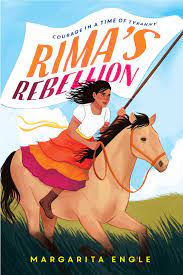
Rima’s Rebellion: Courage in a Time of Tyranny (Feb. 15, 2022) by Margarita Engle.
   Genre: Young adult historical fiction
   Type: Verse novel
            Spanning a decade from 1923, when Rima Marín is 12, until 1933, Rima looks toward a better future in Guanabacoa, Cuba. During that time in Cuba, females have zero right to vote, and Rima will have even fewer rights, as she is a natural child, an illegitimate one. She is bullied and shunned, including by the church. She knows her father. Rima, her mother and abuela (grandmother) live on property owned by her father, but he does not give her his last name. That’s why Rima only has one last name. She loves to ride her horse, Ala, and rides alongside las mambisas, fierce women who fought during Cuba’s wars for independence. She wants to see the day where there’s no fear or shame in being a woman, nor in being natural, and the Adultery Law is abolished. This YA novel is told in verse, but not of the rhyming variety. Though much of the story is turbulent, there is hope and even falling in love. It’s a feminist tale and a worthy read, though with the verse design and the decade that passes in around 200 pages, the fast-paced plot did move too quickly.
The Summer of June (May 31, 2022) by Jamie Sumner.
   Genre: Middle-grade realistic fiction
   Type: Chapter book  
            11-year-old June Delancey is a wonder to behold. It's the top of summer. She's shaved her head, which she later regrets and winds up with an electric blue wig. She plans to beat her anxiety. She meets poetry-loving, soccer-playing Homer Juarez going about her volunteering at the library where her single mom works as the young adult librarian at Columbia Public Library (Columbia, Tennessee) and learns from Luis Silva about how to care for plants, finding that her secret garden brings respite from her extreme anxiety. She impulsively stops taking her meds and continues to get little sleep at night with disastrous results. Sumner creates a vivid piece of fiction that gives a realistic portrayal of the weight an extremely over-anxious mind can have. It encourages openness about and discussion around the topic of mental health and highlights the power of friendship. It isn't a story all about anxiety; it is a hopeful story, too. 
The T. rex Attack (Apr. 12, 2022) by Rex Stone.
   Louise Forshaw, illustrator.
   Genre: Children’s dinosaur fiction
   Type: Middle-grade chapter book
            The first in the Dinosaur Club series, this story follows Jamie (who’s new to Ammonite Bay) and Tess as they discover a secret cave that leads them into a world of dinosaurs, some carnivorous (like the Tyrannosaurus Rex) and others herbivorous (like the Wannanosaurus). While some of the dinosaur names may be difficult for emergent readers without assistance, the chapter book appears to contain fun “Dino Data” facts at the end, and the story itself is adventurous without being scary. I expect my nephew will like this book when he reaches chapter book level. (P.S. I thought this might be considered an early reader book, but the libraries in the region classify it as middle-grade/juvenile fiction.)

Saturday, August 20, 2022

"Crossfire" by Lynette Eason

Crossfire (Aug. 2, 2022)​ by Lynette Eason.*
There’s a situation, and hostages are involved. Julianna Jameson is called on as the negotiator; she works for the FBI as a special agent. When there are no eyes and ears in the courtroom where this is going down, it’s thanks to SRO Clay Fox’s sister, Reese, that they know anything going on. Quick thinking determines where the hostage taker and his cronies will tunnel out. Julianna’s never lost any hostages and someone - or more than one someone - plans to change that. Too soon, Julianna is personally requested as a negotiator on-scene, but she isn’t given a chance to negotiate for the lives of the hostages. Things become far more personal when someone enters her house unbeknownst to her and, later, runs her off the road and kidnaps her 18-year-old sister, Dottie. When the perpetrator is caught, they all think they can breathe a sigh of relief, but all is not over. A person from Julianna’s past places full blame on her from a tragedy almost 15 years ago. As Julianna pushes to identify the perpetrator, it is clear that she’s interested in Clay and him in her. Will their romantic interest have a chance to bloom or will tragedies from both their pasts wither away the potential for true love?
            Every time I read Eason’s stories, I feel like a victor. I love that Revell Books introduced me to this author, and I’ve kept up with her stories ever since. This second in the Extreme Measures series features what I would expect of Eason: fierce, independent leading females, strong but sensitive lead-role-opposite males, despicable antagonists and healing, growth and faith. There is the theme of multiple characters of strong faith and at least one whose faith struggles, but that’s one of the areas where growth is seen. The plot is intense and fast-paced. The story takes you on a ride so fast it’s hard to catch your breath. The dynamic amongst characters is well thought out, even down to how Julianna negotiates with hostage takers. Yes, it’s fiction, but it reads so realistically, such is Eason’s skill. Eason’s novels are an excellent choice for fans of inspirational, romantic suspense novels. I look forward to the next in the series!
            Book 1: Life Flight

* Disclosure of Material Connection: I received this book free from Revell Books. I was not required to write a positive review. The opinions are expressly my own. I am disclosing this in accordance with the Federal Trade Commission’s 16 CFR, Part 255: “Guides Concerning the Use of Endorsements and Testimonials in Advertising.”

Friday, August 19, 2022

"The Color of the Sky is the Shape of the Heart" by Chesil

The Color of the Sky is the Shape of the Heart (Apr. 5, 2022) by Chesil.
   Takami Nieda, translator.
*This is a standalone novel.*
What do you do if the sky is falling? Ginny Park (a.k.a. Pak Jinhee) wonders this after reading a crumpled slip of paper in Stephanie’s writing. Stephanie is not a relative. She’s her host mother and an award-winning children’s book author. Ginny’s path has been uneasy. Growing up as a Zainichi Korean (ethnic Koreans residing in Japan) in Tokyo littered her path with its own kind of discrimination (“And so, an invisible thirty-eighth parallel line was drawn in Japan, too.”), but she also experiences discrimination at the Korean school in Japan. She isn’t fluent in Korean, but Japanese. She’s eventually expelled from that school and then expelled from a Catholic high school in Hawaii. Now she’s in Oregon with Stephanie. Ginny continues to feel like she should be on-the-run and is again about to face expulsion if she doesn’t apply herself academically. She has been traumatized and has tried exacting her own revolution, but needs to find acceptance and forgiveness of herself as part of her autonomy.
            This slim novel with a long title packs a punch. As with any story, it’s not going to fit with every reader, despite Ginny/Jinhee being a complex character who’s thoughtful and rebellious, sorrowful yet angry. The novel is comprised of short chapters, but it traverses deep and sensitive subjects like discrimination, racism, diaspora and the struggle to feel like one belongs somewhere, anywhere. Ginny brims with passion and determination, but isn’t without doubt and questions and perhaps some depression. Its length doesn’t signify that it’s a fluff read; it is thought-provoking, and if it isn’t to some readers, it should be. For me, her experiences in Japan as Zainichi are far different than any discrimination I’ve experienced because of my race (mine’s been any-type-of-Asian in mostly Caucasian settings), though her line, “…and as an Asian, I was constantly being harassed by both” resonated much stronger than I’d like. I don’t know how much is total fiction and how much is fiction that’s based on the author’s life, but it’s a powerful little novel. Identity is complex, and it doesn’t take 500 pages to showcase that. Sometimes it only takes 158.
            P.S. I wish I read Japanese fluently, as I imagine it must’ve been striking to read in its original language. Nieda’s translation is impactful and rendered so eloquently that it’s graceful.
            P.P.S. The original title, romanized, is Jini no pazuru, which translates as Jini’s Puzzle. I’m incredibly curious how it went from that to “The Color of the Sky is the Shape of the Heart” when translated to English!
            P.P.P.S. Sorairo wa kokoro moyou = The color of the sky is the shape of the heart.